Anxiety
Behind the comic
What is your research about - in one sentence?
We explore how individuals with anxiety and depression perceive, interpret and predict the environment by measuring cognitive responses to emotional situations, and brain and heart activity.
What does the comic show?
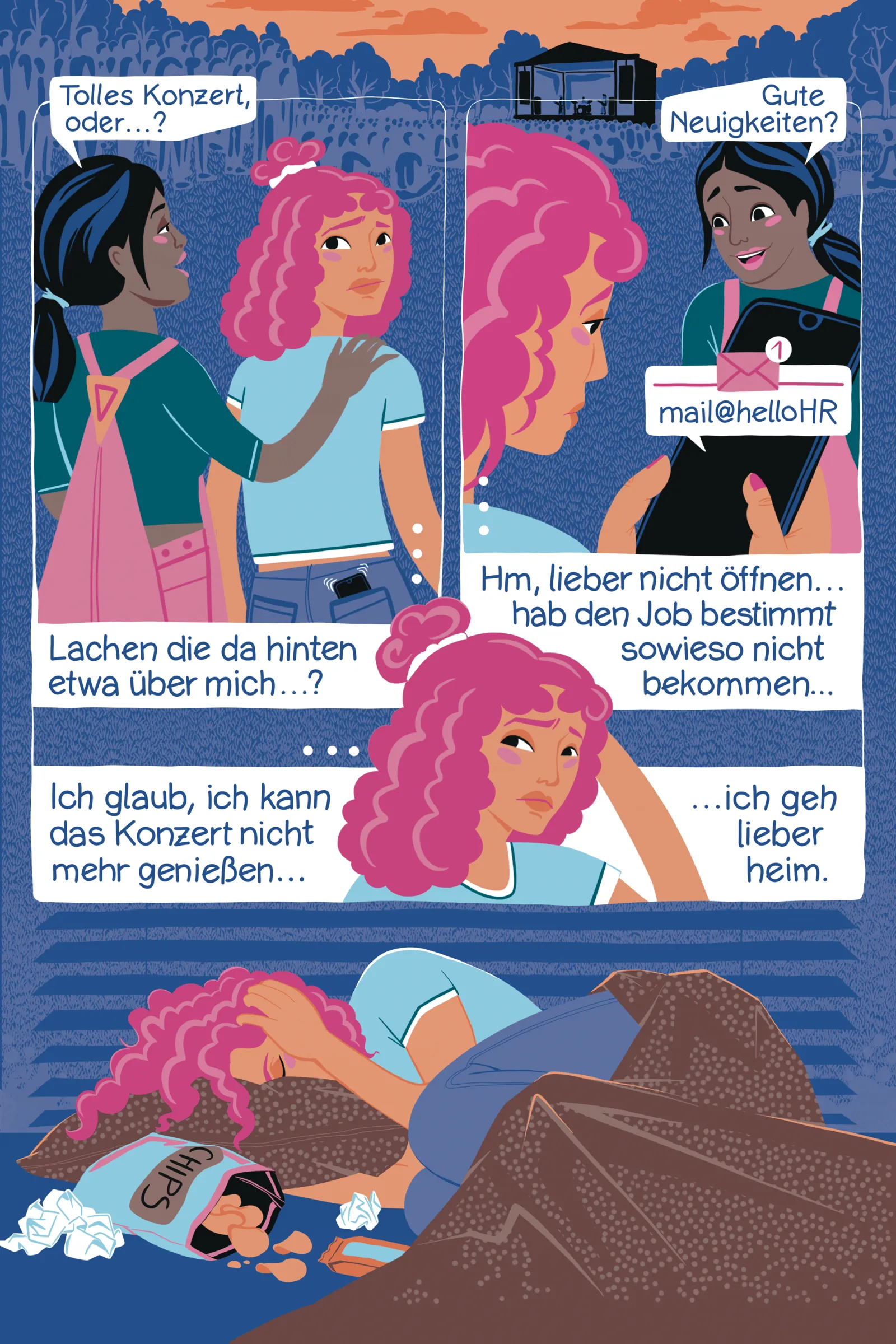
Our comic illustrates how emotional information can be perceived differently among people with anxiety and depression.
The first scene shows two friends, Anna and Julia, at a concert. They hear people laughing and Anna interprets it as them enjoying themselves, while Julia thinks they are laughing at her.
In the second scene, Julia receives an email and Anna immediately thinks it is good news, while Julia expects a negative outcome before even opening the email.
The third situation illustrates Julia feeling emotionally unwell. She has been paying more attention to negative information, interpreting situations as being more negative, and expecting negative outcomes. These cognitive processes contributed to her feeling worse and unable to enjoy the concert. The very last scene in the comic shows Julia lying in bed, feeling depressed. This concluding scene depicts how anxiety and depression disorders are not only about “feeling sad” or “being nervous” but involve a complex interaction between the brain, the body, and the way we think.
What findings support this idea?
Anxiety and depression are among the most common mental health challenges worldwide. Almost one in five people will experience them at some point in life. Most diagnoses are based on self-reports of feelings and behaviors, which are not always precise, making it hard to find the right diagnosis and treatment.
Research has found that cognitive biases are central to anxiety and depression. These are systematic ways of processing information in a biased way, for example; focusing more on negative information, expecting the worst, or interpreting neutral situations as threatening. Such patterns make everyday life feel more difficult and feed into cycles of anxiety or depression. Previous research from our group has shown that cognitive bias patterns can predict diagnosis and symptom severity with high accuracy, providing a more objective basis for diagnosis and the foundation for future interventions tailored to each person's individual difficulties.
What are the limits and common misunderstandings?
Our research does not show that cognitive biases alone determine people’s thoughts, emotions, or behaviour. Other factors — such as stress and the social environment — can influence how these biases express themselves.
Differences in cognitive biases between anxious and depressed individuals are often subtle and situation-dependent. These biases also vary from person to person, so not everyone with the same disorder will experience the same cognitive bias.
It is also important to remember that mental health disorders are usually influenced by multiple cognitive biases. Because of this, treating one bias will not necessarily make symptoms disappear.
Some treatments aim to reduce cognitive biases to improve symptoms, but results are mixed: some studies show improvement, while others find little or no effect. Overall, cognitive biases should be understood as one piece of a much larger puzzle, where many factors work together.
What questions are still unanswered?
Many important questions are still unanswered. Researchers do not fully know whether cognitive biases help cause mental health disorders, appear as a result of them, or both. For example, people with anxiety often focus more on threats, but it is not clear whether this “threat focus” comes before the anxiety or develops because of it.
It is also unclear why some people who do not have mental health problems still show cognitive biases. Some people may be more vulnerable than others, but it is not well understood what protects certain individuals from developing disorders.
Another open question is whether cognitive biases are long-lasting traits, temporary reactions to situations, or something that changes with mood and life circumstances.
Importantly, researchers are still trying to understand why people with the same diagnosis react differently to similar situations. Finally, it is not yet clear which treatments work best, who benefits most from them, and how long any improvements last.
How could this shape future medicine?
Diagnosis of psychiatric disorders is currently based on self-reported symptoms, which leads to imprecise diagnosis and treatment. More than half of the people with anxiety and depression do not benefit from existing treatments, and finding the right medication after a diagnosis can take months.
By identifying individual cognitive biases, combined with brain and body responses, it becomes possible to diagnose disorders more accurately and match people to treatments that target specific patterns of reactions. Someone who has a lot of negative expectations may respond better to cognitive restructuring, while someone with strong physiological reactivity might benefit more from body-based approaches.
This also means that cognitive biases can be measured before symptoms become severe, meaning personalised support could begin before a crisis occurs. In the long run, this shift from reactive to proactive, individualised care is one of the most promising directions in mental health.
What societal and ethical questions does this raise?
This research paves the way to more personalized mental health care. Clinicians could move towards treatments tailored to each person's specific pattern of cognitive, emotional and physiological reactions. This could reduce the long trial-and-error process many people experience. It also helps reframe anxiety and depression as measurable processes rather than personal failings, which may reduce stigma.
However, the focus on measurements should not be at the expense of the individual experience. Our methods should always support and be integrated with clinical conversations, where clinicians continue to ask people seeking help how they feel and think about their difficulties. Second, there is the question of accessibility. Methods like magnetic resonance imaging and electrocardiography are expensive and not widely available. For this reason, we aim to first identify reliable patterns of these signals and translate them into simpler cognitive measures that could be used more broadly.
How do you study this topic?
We investigate how cognitive biases relate to brain activity, bodily responses, and psychological symptoms in anxiety and depression disorders. We use an interdisciplinary approach combining psychology, neuroscience, computer science, and medicine. The study includes participants with anxiety and/or depression and a healthy control group. With the clinical group, we conduct a structured clinical interview to assess diagnosis and symptom severity. All participants complete computerized questionnaires on thoughts, emotions, physical symptoms, and demographic and health information. In a second session, both groups undergo fMRI where they perform tasks on attention, interpretation, and expectation, while we measure brain activity in different brain regions. Heart activity is recorded using ECG, and blood pressure is measured at the end. The data is anonymised and then statistically analyzed to identify neural, cognitive and physiological patterns of reactions that uniquely characterise subtypes across the disorders.
Where can I learn more about this topic?
If you would like to learn more about anxiety and depression disorders and related neural and physiological mechanisms, it is worth visiting the websites of the Society for the German Psychological Society, and the German Association for Psychiatry, Psychotherapy, Psychosomatics and Neurology.
If you are interested in participating in the study, you can find further information on our website below or contact us via email (emocog-study@cbs.mpg.de).
If you are experiencing depressive thoughts, psychological distress, or similar difficulties, please contact the nationwide medical on-call service and patient service in Germany, which can help insured individuals arrange timely appointments for psychotherapeutic consultations or, in urgent cases, acute treatment. In addition, the Leipzig Alliance Against Depression is a helpful contact point offering support and guidance in finding appropriate mental health services.
German Psychological Society: https://www.dgps.de/
German Association for Psychiatry, Psychotherapy, Psychosomatics and Neurology: https://www.dgppn.de/
Nationwide medical on-call service and patient service in Germany, Tel.: 116 117 https://www.116117.de/de/psychotherapie.php
Leipzig Alliance Against Depression: https://buendnis-depression-leipzig.de/
Participating in the clinical group: https://www.cbs.mpg.de/studiengesuche/emocog-study
Participating in the control group: https://www.cbs.mpg.de/studiengesuche/emocog-study-kontrollgruppe?c=2242803
References
For reading about previously published studies about cognitive biases in anxiety and depression you may visit these links or write to us and ask for the papers (emocog-study@cbs.mpg.de).
Using machine learning-based analysis for behavioral differentiation between anxiety and depression (Richter et al., 2020) https://www.nature.com/articles/s41598-020-72289-9
Machine learning-based diagnosis support system for differentiating between clinical anxiety and depression disorders (Richter et al., 2021) https://www.sciencedirect.com/science/article/pii/S0022395621004180
Disorder-specific versus transdiagnostic cognitive mechanisms in anxiety and depression: Machine-learning-based prediction of symptom severity (Richter et al., 2024) https://www.sciencedirect.com/science/article/pii/S0165032724004506
World mental health report: Transforming mental health for all. World Health Organization.(World Health Organization, 2022). https://www.who.int/publications/i/item/9789240049338
Threat-related attentional bias in anxious and nonanxious individuals: a meta-analytic study (Bar-Heim et al., 2007) https://doi.org/10.1037/0033-2909.133.1.1
The effects of emotion on attention: A review of attentional processing of emotional information (Yiend, 2010) https://doi.org/10.1080/02699930903205698
Where it's set
About the Project
Science Streets ist ein Wissenschaftskommunikationsprojekt, das Wissenschaft in den Alltag bringt, indem es Leipzigs öffentliche Räume zu Lernorten macht. Für vier Wochen im August 2026 werden Science-Comics auf Werbeflächen (Litfaßsäulen, City-Light-Postern, Infoscreens, im öffentlichen Nahverkehr usw.) gezeigt. Das diesjährige Thema lautet Neurowissenschaften. Zehn Wissenschaftler*innen und zehn Illustrator*innen werden ausgewählt, um gemeinsam Comics rund ums Gehirn zu gestalten – die Wissenschaftler*innen liefern die Inhalte, die Illustrator*innen setzen diese künstlerisch um.
Videos
More Comics