Predictive Brain
Behind the comic
What is your research about - in one sentence?
The way we perceive the world is not only determined by the signals coming from our surroundings, but also by our previous experience and knowledge.
What does the comic show?
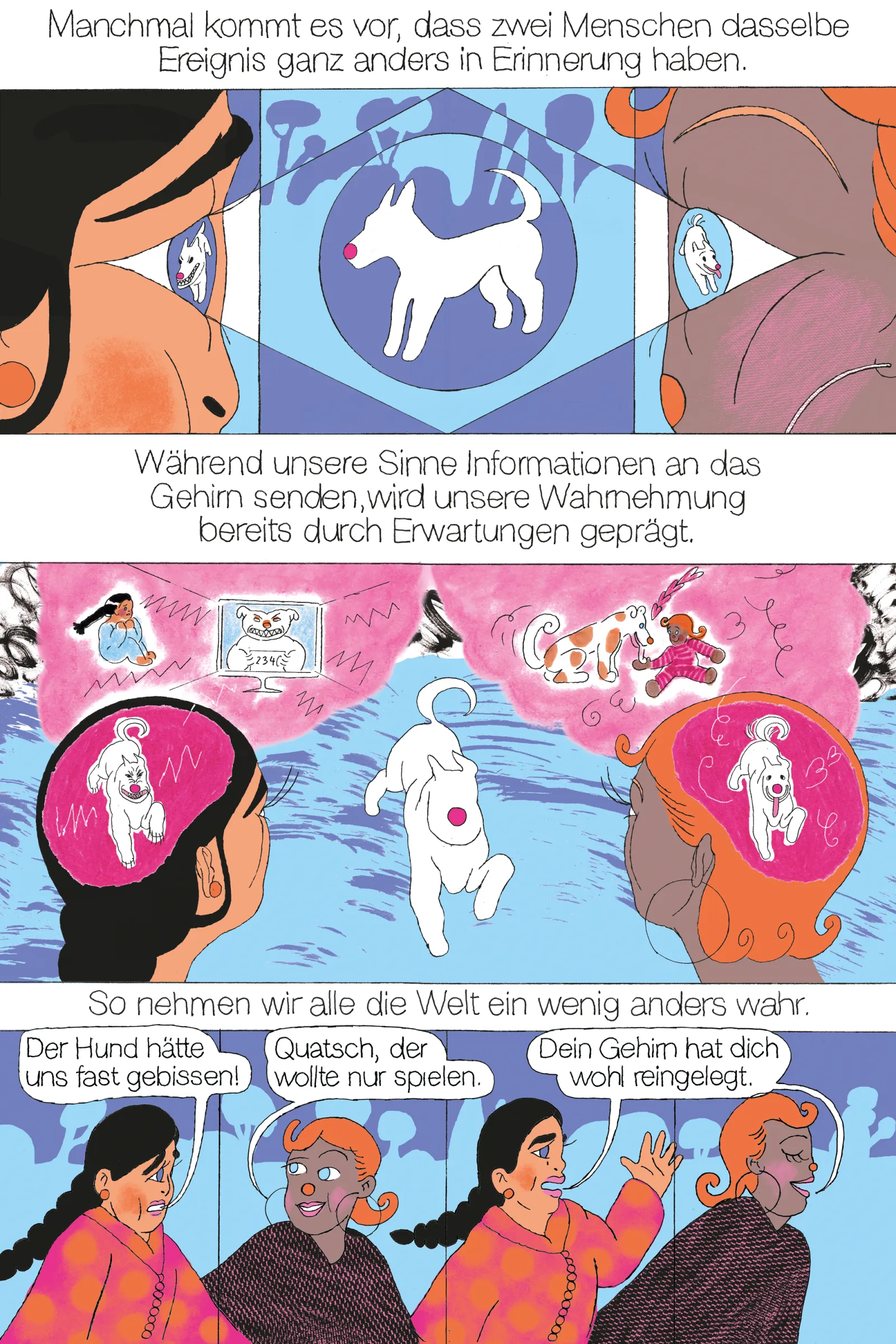
The comic shows how two people can see the same event but experience it differently because their brains expect different things. In the panels, a single dog triggers two very different mental scenes. One person remembers danger, the other remembers playfulness, even though the visual input is identical. The comic highlights that perception is not just a passive recording of the world: the brain uses memories, context, and recent events to predict what will happen next and to fill in missing details. Those predictions influence what we notice, how quickly we understand it, and what we later remember. The final panel, where the two people describe the same moment in opposite ways, is a simple example of how predictions can shape everyday experience.
What findings support this idea?
Multiple lines of research show that expectations shape perception. Brain recordings reveal automatic responses when an expected sound or image is changed. The brain flags surprises and updates its expectations. Language studies show that unexpected words cause bigger brain responses than expected ones, indicating active prediction during comprehension. Behavioral priming experiments demonstrate that recent experience makes related things easier to notice and recognize. And classic Gestalt principles (like grouping and continuity) show how the brain tends to bind parts of a scene into coherent wholes. It is a kind of built-in expectation about how things usually go together. Altogether, these findings support the idea that perception is a continuous mix of incoming information and prior knowledge.
What are the limits and common misunderstandings?
This work does not mean our senses are useless or that perception is only imagination. Sensory input still matters. The brain combines what it experiences with what it expects, and which one wins depends on the situation. Predictive processing is not a single, finished theory but a useful framework with different versions; not every experiment or brain signal maps perfectly onto the idea. Also, perceptual differences are not always conscious choices or "errors". Many are automatic and helpful. Finally, individual life history, attention, culture, and neurodiversity all influence how much people rely on predictions, so findings from one group or task don’t apply to everyone.
What questions are still unanswered?
One big open question is how the brain decides what to trust more: what is coming in through the senses, or what it already expects. Researchers are still trying to understand how memories, emotions, stress, culture, and personal experience shape these stories.
Another question is why some expectations are easy to update, while others become very strong. When does a prediction help us react quickly, and when does it mislead us? This matters not only for simple perception, but also for learning, misunderstandings, prejudice, and mental health.
We also do not yet fully understand why people differ so much. Some may notice threat very quickly, others may focus more on playfulness or curiosity. How the brain builds these different versions of reality is still an active field of research.
How could this shape future medicine?
This research could help future medicine become more personalsed. People do not only differ in their bodies, but also in how their brains interpret signals from the world. The same sound, facial expression, pain, or social situation can feel different depending on a person’s expectations and previous experiences. This is especially relevant for mental health. For some people, the world may often feel threatening, overwhelming, unpredictable, or emotionally flat. Research on predictive perception may help explain why this happens and how support could be adapted to the individual. In the future, simple behavioural tasks or digital tools might help track how someone reacts to uncertainty, surprise, or repeated patterns. This could support earlier detection, better communication between patients and clinicians, and more personalised treatment. The goal is not to say “it is all in your head”, but to understand how each brain makes sense of the world.
What societal and ethical questions does this raise?
This research can help us become more aware that people may honestly experience the same situation differently. In our comic, one person remembers the dog as dangerous, the other as playful. Neither reaction comes from the eyes alone. Both are shaped by what the brain expects.
This insight can support empathy, education, design, and public communication. Teachers can connect new information to what learners already know. Designers can build tools that feel more intuitive because they fit people’s expectations. Museums and media can show how the same event may look different from different perspectives.
But there are ethical risks too. If expectations shape what we notice and believe, they can also be influenced or manipulated. Advertising, social media, and recommendation systems may strengthen existing assumptions instead of challenging them. Digital tools that infer a person’s mood or inner state from behaviour also raise privacy questions. Understanding prediction should help people reflect, not be used to control them.
How do you study this topic?
We study perception by creating situations in which the senses alone do not give a clear answer. Participants might hear sounds, see images, or judge ambiguous situations. We then ask simple questions: What did you notice? What did you expect? Did something seem threatening, familiar, surprising, or unclear?
A key method is to keep the physical input the same while changing the context around it. For example, the same image can be interpreted differently after different instructions or previous experiences. The same sound can also be heard differently when it is repeated or placed in a different situation.
We measure people’s choices, reaction times, confidence, and sometimes brain responses. This helps us separate what is physically present from what the brain adds, predicts, or updates. In short, we design small moments of uncertainty and study how the brain turns them into a meaningful experience.
Where can I learn more about this topic?
More information on predictive coding: https://www.youtube.com/watch?v=5eSxcygk8UM, https://www.frontiersin.org/research-topics/599/predictive-coding
Information about brain responding to unexpected events: https://neuralcrossroads.ucsd.edu/files/2017/03/BrainWaves_L24-1.pdf
More information on Gestalt psychology: https://neurotectura.com/2025/08/15/the-science-of-perception-how-gestalt-principles-influence-us/
References
Where it's set
About the Project
Science Streets ist ein Wissenschaftskommunikationsprojekt, das Wissenschaft in den Alltag bringt, indem es Leipzigs öffentliche Räume zu Lernorten macht. Für vier Wochen im August 2026 werden Science-Comics auf Werbeflächen (Litfaßsäulen, City-Light-Postern, Infoscreens, im öffentlichen Nahverkehr usw.) gezeigt. Das diesjährige Thema lautet Neurowissenschaften. Zehn Wissenschaftler*innen und zehn Illustrator*innen werden ausgewählt, um gemeinsam Comics rund ums Gehirn zu gestalten – die Wissenschaftler*innen liefern die Inhalte, die Illustrator*innen setzen diese künstlerisch um.
Videos
More Comics